Thomas J. Barry becomes half owner of a small millwright and general repair shop in the south part of St. Louis, Missouri (USA).
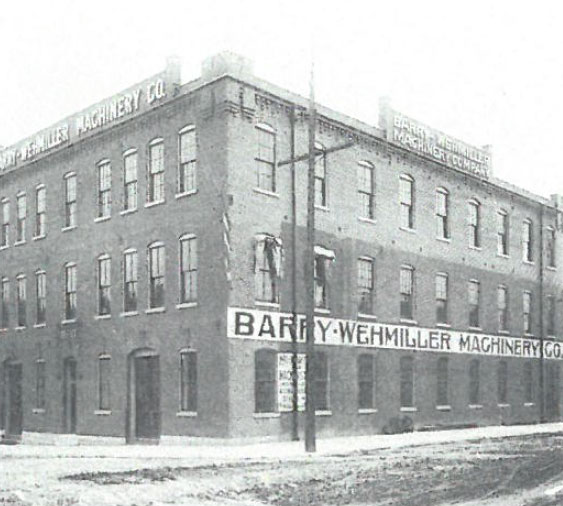
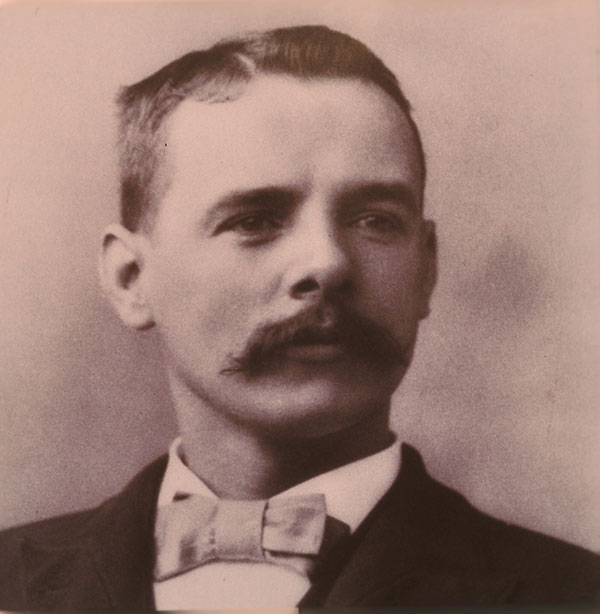 Barry opens a machine shop at 21st and Walnut streets, in St. Louis, Missouri (USA), to provide conveying and transportation equipment to malt houses. At this time, St. Louis was third in the nation for beer production—Anheuser-Busch alone sold 500,000-plus barrels of beer.
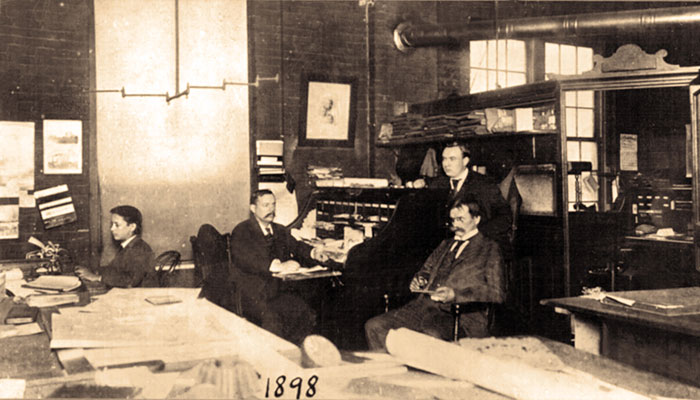
 Alfred Wehmiller, Barry’s brother-in-law, joins the millwright business as a draftsman.
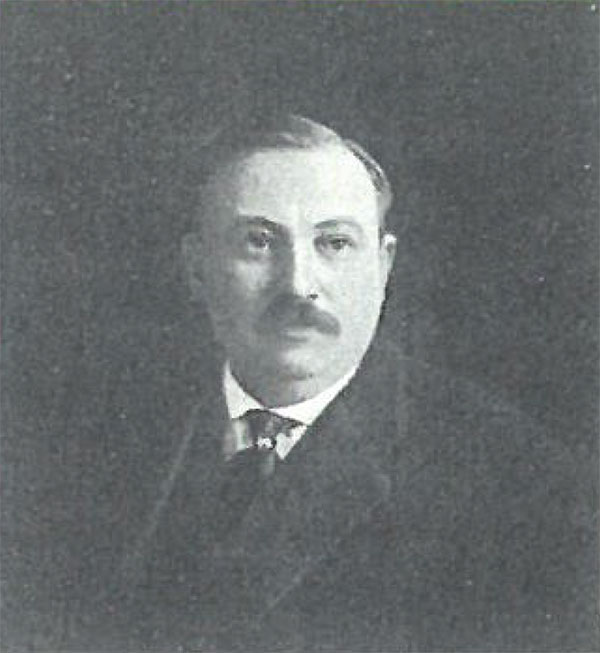 The Barry-Wehmiller Machinery Company is incorporated; with Barry as president and Wehmiller as secretary.
The company designs and erects its first continuous basket pasteurizer, an economical machine that totally submerged refillable bottles. A soaking machine also is developed to fill and empty bottles of various solutions.
From a Catalog: "Our soaking machines were the first ever built in which the tank was divided up into compartments or sections by transverse partitions, and in which the general direction of travel of the bottles was vertical instead of horizontal."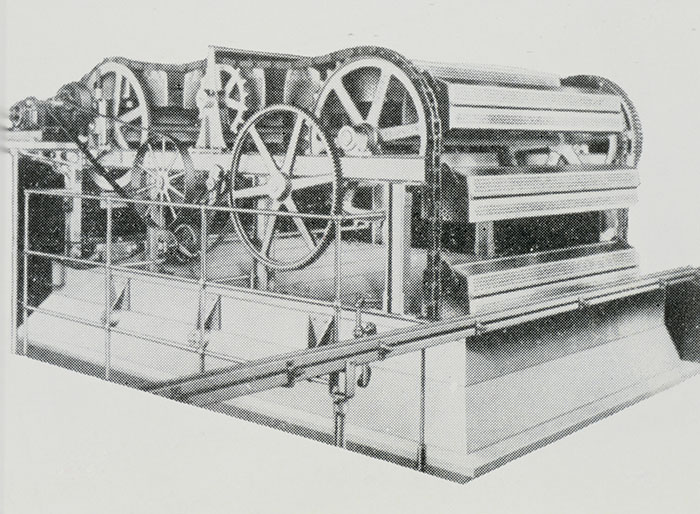 Barry dies, and Wehmiller becomes president and treasurer.
Barry-Wehmiller builds a new plant at 4660 West Florissant Avenue in St. Louis, Missouri (USA), with strategic access to railroads, moving from 21st and Walnut streets, which had housed the company since 1888.
From a Pamphlet: “The location affords unsurpassed railroad connections for the plant, which is supplied with three separate private switches for the transportation of all raw and finished products to and from the different buildings."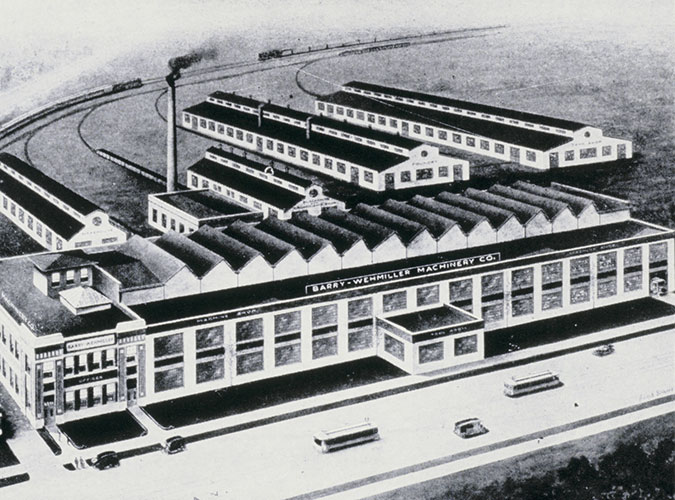
Wehmiller is recognized for his contributions to the dairy industry.
From a Press Notice: “Head of the Barry-Wehmiller concern, is one of the few St. Louisans who deserves the gratitude and praise of countless thousands of people throughout this country, for he is the inventor of the famous ‘Barry-Wehmiller Way’—equipment which is justly claimed and proved to be the ‘Last Word’ in the production of ‘Safe Milk’…. The Barry-Wehmiller wonderful equipment washes and sterilizes the bottles, fills them with clarified milk, seals them air-tight, submerging them for one hour and twenty minutes, pasteurizing the milk at 145 degrees and cooling it to 36 degrees.”
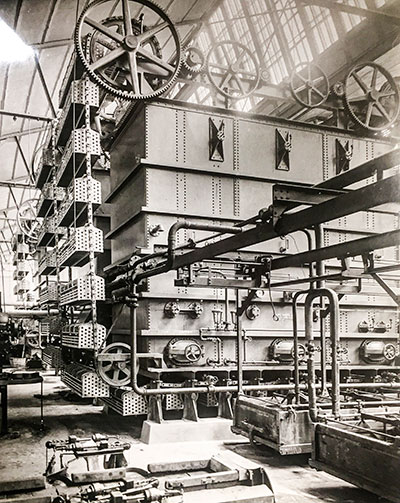
Patent application granted to Wehmiller and Barry-Wehmiller for a “method of pasteurizing liquids.”
Prohibition begins, and facing an 80 percent loss in US sales, Barry-Wehmiller focused on the international brewing industry and the production of dairy washers and pasteurizers, introducing the patented National pasteurizer during this time.
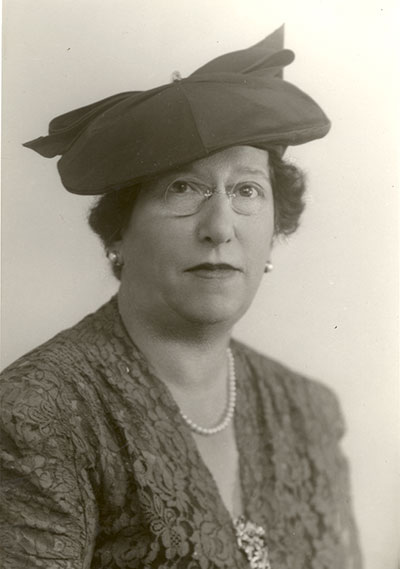
 Wehmiller dies, and his widow, Lillie, becomes president.
Prohibition ends, reinvigorating the bottling machinery business and the brewing industry. In anticipation of the repeal of Prohibition, the Super-National bottle cleaner is developed.
From an internal quarterly review published to honor the company’s 75th anniversary: “The first year of repeal brought a return of the annual brewers’ convention…. It was at these yearly meetings that Lillie proved herself to be an indispensable asset to the company. Her gay good humor, her inexhaustible energy and her great interest in people made her a natural good-will ambassador.”
Alfred Wehmiller’s son Fred joins the company as a vice president after graduating from college the year before.
Fred is named general plant superintendent.
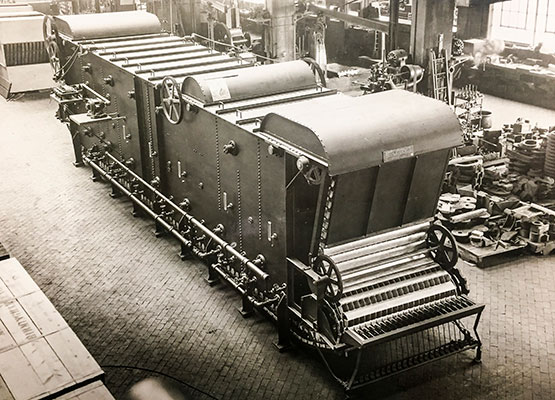 The revolutionary BW Vortex pasteurizer is introduced, expanding Barry-Wehmiller’s reach both within and outside of the brewing industry.
Alfred Wehmiller’s son Paul is named a vice president, and devotes his time to US and international sales, especially in South America.
The revolutionary BW Vortex pasteurizer is introduced, expanding Barry-Wehmiller’s reach both within and outside of the brewing industry.
Alfred Wehmiller’s son Paul is named a vice president, and devotes his time to US and international sales, especially in South America.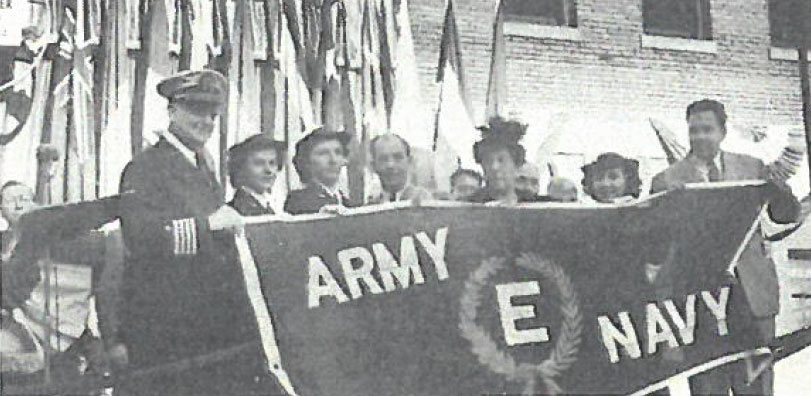
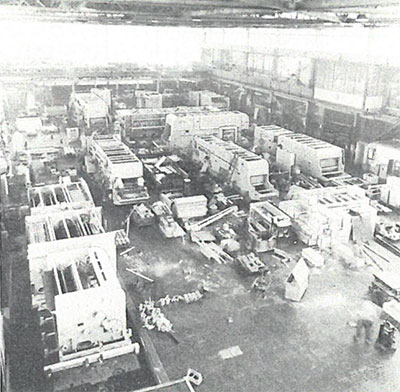
Barry-Wehmiller earns the Army-Navy “E” Award for its support of World War II production needs. The company converted its facilities to produce 20mm projectiles, shell washers, components and fixtures for bomber turrets, gun yokes and other machine tools; team members grow victory gardens on the grounds.
From a US Navy website: “Representing only 5 percent of the estimated war plants in the nation, those plants meeting the stringent eligibility requirements ranged in size from a one-man plant to large corporations and included facilities that converted from peace to war production, as well as new plants built especially for war purposes…. Excellence in quality and quantity of production were two of the determining factors in granting Awards.”
Barry-Wehmiller’s research department is founded to improve bottling machinery.
A departure from the Super-National and its cleaning brushes, the International all-hydro bottle cleaner is introduced, with an impressive recommended operating speed of 500 bottles/minute.
 Lillie Rassieur (formerly Wehmiller) resigns as president. Fred becomes president, and Paul is named executive vice president.
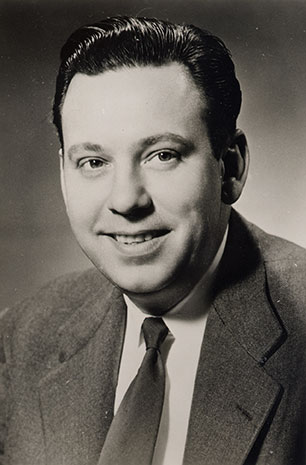 William A. Chapman joins Barry-Wehmiller as executive assistant to Fred. Bill had been involved with the company as an Arthur Andersen accountant.
 Barry-Wehmiller acquires the rights to manufacture the Hydro-Jet bottle cleaner for non-labeled bottles (soft drinks, primarily) and the New-Matic uncaser from the Liquid Carbonic Corporation.
Fred dies, and Bill Chapman becomes president. He had previously served as vice president, general manager and treasurer. With the growth of canned beer, nonreturnable glass and German competition, the company struggles to stay in business.
Barry-Wehmiller de México S. A. de C. V. is formed in Mexico City to provide reliable technical advice, and to supply quality repair and maintenance parts more quickly and affordably.
The Jagenberg Ultra-Tempo labeler is introduced, which impressively operates at 300 bottles/minute for paper labels and 250 bottles/minute for foil.
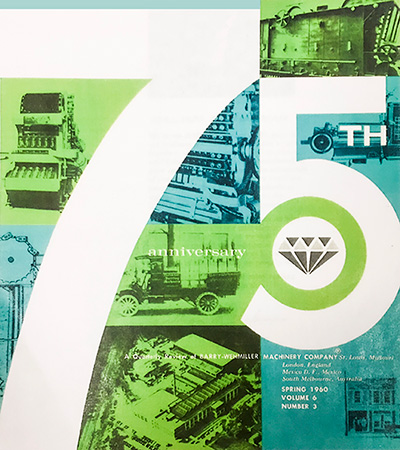
Barry-Wehmiller celebrates its 75th anniversary.
From an internal quarterly review published to honor the milestone: “Old timers at Barry-Wehmiller are a dime a dozen. Twenty and thirty year service records are common. Father and son or father and daughter combinations are on the payroll. Many a St. Louis parent has said, ‘Try to get a job there. Wait if you have to. It’s always been a good place to work.’”
Barry-Wehmiller acquires the rights to manufacture the Hydro-Jet bottle cleaner for non-labeled bottles (soft drinks, primarily) and the New-Matic uncaser from the Liquid Carbonic Corporation.
Fred dies, and Bill Chapman becomes president. He had previously served as vice president, general manager and treasurer. With the growth of canned beer, nonreturnable glass and German competition, the company struggles to stay in business.
Barry-Wehmiller de México S. A. de C. V. is formed in Mexico City to provide reliable technical advice, and to supply quality repair and maintenance parts more quickly and affordably.
The Jagenberg Ultra-Tempo labeler is introduced, which impressively operates at 300 bottles/minute for paper labels and 250 bottles/minute for foil.
Barry-Wehmiller celebrates its 75th anniversary.
From an internal quarterly review published to honor the milestone: “Old timers at Barry-Wehmiller are a dime a dozen. Twenty and thirty year service records are common. Father and son or father and daughter combinations are on the payroll. Many a St. Louis parent has said, ‘Try to get a job there. Wait if you have to. It’s always been a good place to work.’”
Barry-Wehmiller holds 34 US patents and 84 patents in 14 other countries.
Said Bill Chapman: “The acceptance of our products through the years could not have resulted alone from the standards of quality they set, but is also due to the loyalty and support of our employees.”
Barry-Wehmiller introduces new branding!
 Ownership passes to the Chapman family.
Bob Chapman joins Barry-Wehmiller.
Ownership passes to the Chapman family.
Bob Chapman joins Barry-Wehmiller.
 Barry-Wehmiller introduces new branding!

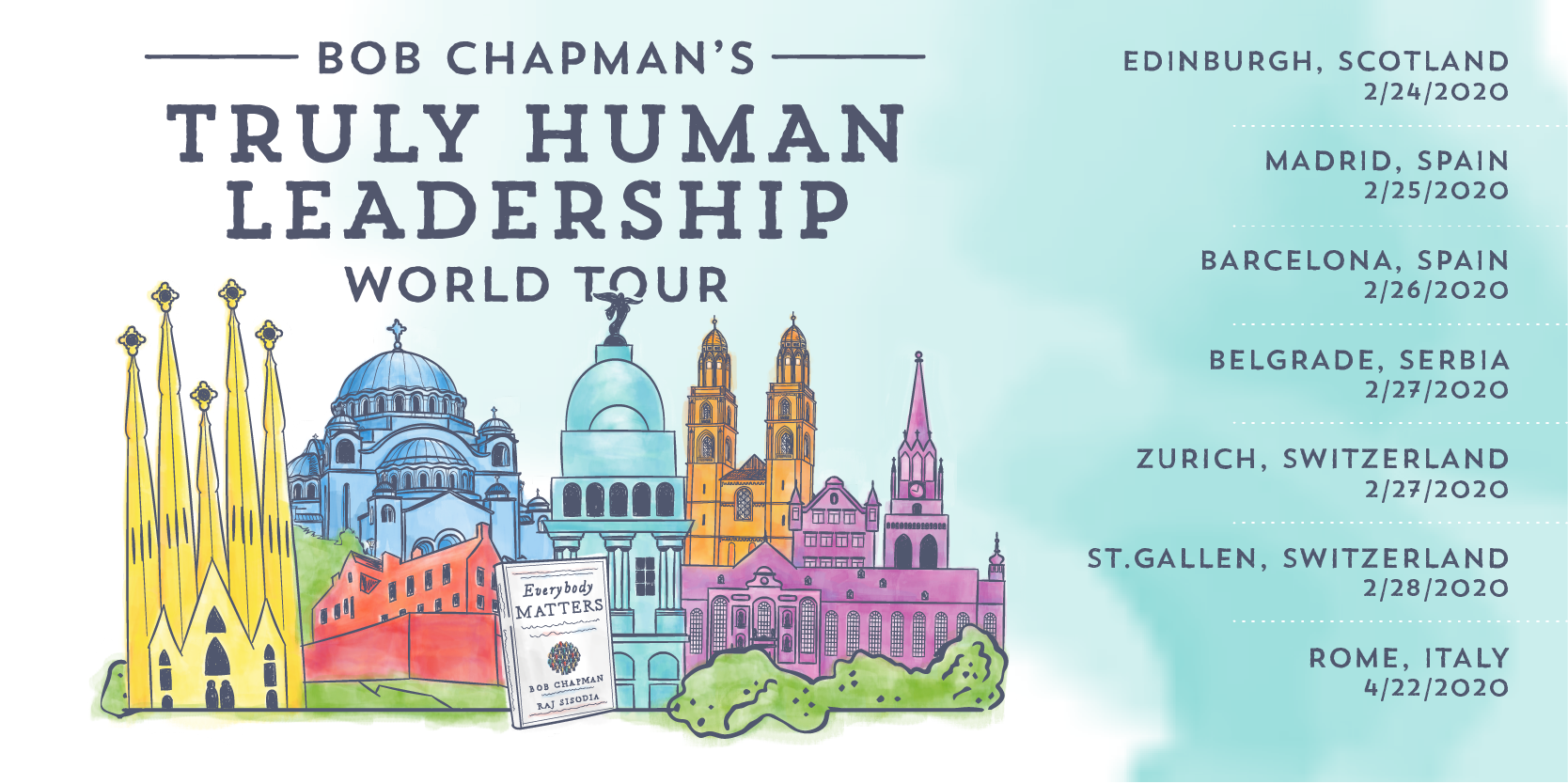
Bob Chapman becomes Chairman and CEO after his father’s sudden death from a heart attack.
Said Bob Chapman: “Within days of my dad’s death, our banker visited and told me they were freezing our line of credit. I remember thinking ‘I am not going down!’ In my mind, I had no other choice than to take direct control, cutting costs and implementing disciplines that ultimately moved the company into record profitability and financial stability within nine months.”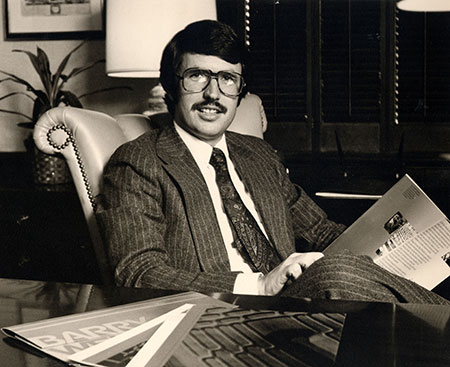 Barry-Wehmiller establishes an operation in Clearwater, Florida (USA), specializing in the design and manufacture of Italian fillers for the Western beverage industry.
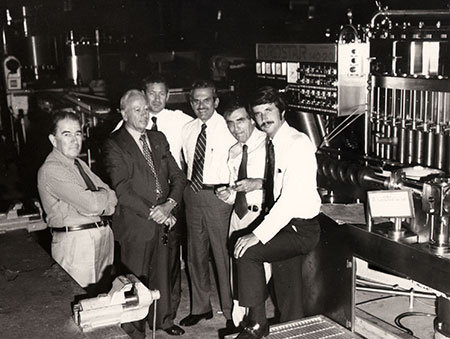 Barry-Wehmiller introduces new branding!
 Sluggish markets, global recession and other economic conditions trigger period of financial decline. Bank pulls the loan a second time. The leadership team challenges itself to reposition the company by redefining the core business and financial strategies.
Barry-Wehmiller Design Group, an engineering consulting firm, headquartered in St. Louis, Missouri (USA), is formed.
Sluggish markets, global recession and other economic conditions trigger period of financial decline. Bank pulls the loan a second time. The leadership team challenges itself to reposition the company by redefining the core business and financial strategies.
Barry-Wehmiller Design Group, an engineering consulting firm, headquartered in St. Louis, Missouri (USA), is formed.
 Barry-Wehmiller spins off two-thirds of the company in a $35 million IPO offering on the London Stock Exchange, divesting control of its European-based company, while retaining ownership of its historic brewery equipment business. This dramatically enhanced Barry-Wehmiller’s financial strength and marked the beginning of the modern chapter in the company’s history. Harvard Business School subsequently wrote a case study on this event in the company’s history.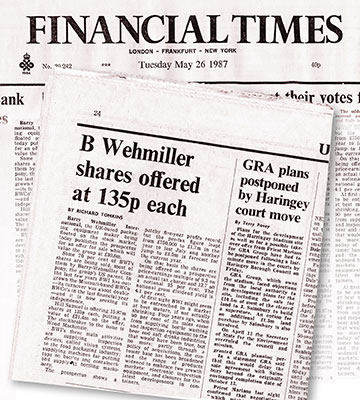
Strategy for Growth, Value and Liquidity established to identify companies and products that fit the vision of an ideal packaging machinery company.
Said Tim Sullivan, Board Member and Former Group President, Paper and Converting: “This strategy helped us focus on creating a business that experienced sustainable and consistent success. We began seeking out companies that complemented our business…ones with a long history and a large installed base of equipment that were struggling and would have a motivation to sell to us.”
Barry-Wehmiller acquires Pneumatic Scale Corporation in Quincy, Massachusetts (USA). It becomes Pneumatic Scale Angelus after the acquisition of Angelus Sanitary Can Company in 2007.
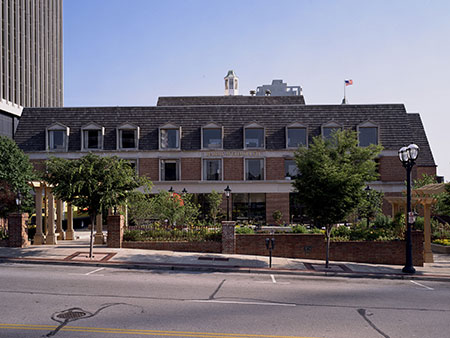
 Barry-Wehmiller moves from 4660 West Florissant Avenue in St. Louis, Missouri (USA), to its current global headquarters at 8020 Forsyth Boulevard, Clayton, Missouri (USA).
 Barry-Wehmiller acquires Accraply Inc., based in Minneapolis, Minnesota (USA).
 Hayssen Inc., in Duncan, South Carolina (USA), is acquired. The subsequent acquisition of Sandiacre Rose Forgrove in 2006 changes name to HayssenSandiacre, and eventually, Hayssen Flexible Systems (now BW Flexible Systems).

 Marquip Inc., of Phillips, Wisconsin (USA), is acquired. The 2002 acquisitions of Ward Machinery Company and United Container Machinery change name to MarquipWardUnited (now BW Papersystems).
 IT consulting firm Barry-Wehmiller International Resources launched, with headquarters in St. Louis, Missouri (USA) (now part of Design Group).

Guiding Principles of Leadership (GPL), Barry-Wehmiller’s cultural vision statement, is drafted and becomes the cornerstone of the culture.
Said Maureen Schloskey, a member of the GPL creation team: “The document we created exemplified how we wanted everyone to treat each other. We had described a ‘perfect culture’ that we would all like to aspire to achieve. One of the proudest moments of my life was when I was asked to put my signature on the bottom of the original GPL document.”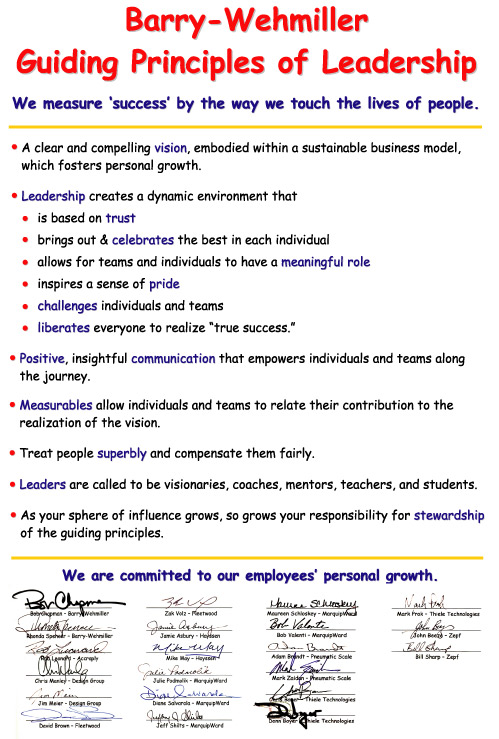
Barry-Wehmiller launches GPL SSR leadership recognition program to honor those team members who embody the traits articulated in the GPL.
Tracy Williams of BW Papersystems was one of the first winners: “This award is one of the most amazing things that ever happened to me. When that car came home, my kids said ‘Wow, Mom. You did that!’”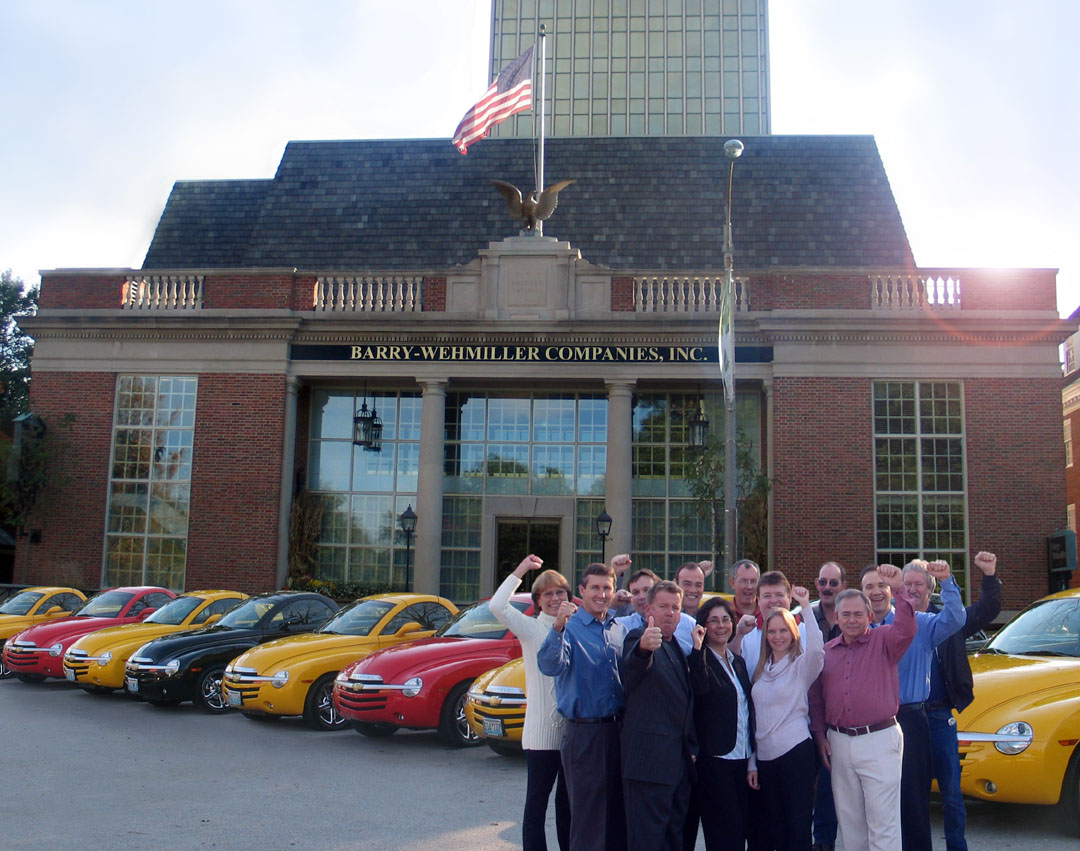 Barry-Wehmiller acquires Paper Converting Machine Company (PCMC) in Green Bay, Wisconsin (USA).
 Living Legacy of Leadership (L3) is created to integrate Barry-Wehmiller’s people-centric leadership with Lean thinking.
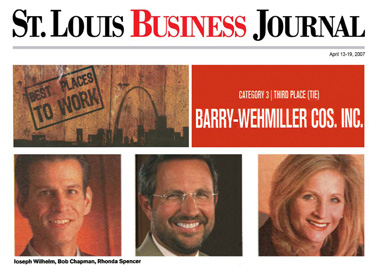
 St. Louis Business Journal names Barry-Wehmiller one of the Best Places to Work in St. Louis, Missouri (USA).
 Barry-Wehmiller founds Barry-Wehmiller University (BWU), a continuous learning program that provides a dynamic educational experience for team members, enabling them to grow, develop, learn, advance and share their gifts with others.
 Barry-Wehmiller revenues surpass $1 billion.
Economic downturn delivers blow to Barry-Wehmiller: 40 percent drop in new equipment orders creates financial uncertainty. Drawing upon the ideals of the Guiding Principles of Leadership and the company’s vision of “measuring success by the way we touch the lives of people” to offer direction, CEO Bob Chapman devises a way past the crisis through shared sacrifice with a furlough program.
Said Bob Chapman: “I asked myself, ‘What would a caring family do when faced with a crisis?’ The answer: Everybody would each take a little pain so that no member of the family would have to experience dramatic loss. Business rebounded well ahead of the broader economic recovery - fiscal year 2010 was a record year in earnings.”
CEO Bob Chapman’s son Kyle Chapman cofounds Forsyth Capital Investors (now BW Forsyth Partners), which combines private equity experience with Barry-Wehmiller’s strategic value creation and people practices.
Said Kyle Chapman: “I am immensely grateful for the influence my dad has had on my family and business life. He has always said that ‘raising a family and running a business are no different.’ I can attest to that, as the lessons he and my mother taught me as a child I still call upon as a business leader today.” Our Community Listens (now Chapman Foundation for Caring Communities), a nonprofit that brings Barry-Wehmiller University’s Communications Skills Training (now Our Community Listens) to communities across the US, holds its first class. This foundational course teaches the fundamentals of listening and leadership, with the goal of positively impacting lives—at work, at home and in the community.
 CEO Bob Chapman delivers TEDx talk at Scott Air Force Base, Illinois (USA). Bestselling author and speaker Simon Sinek hosts the event focused on “Service to Others.” Since then, Chapman’s TEDx talk has been viewed more than 200,000 times on YouTube.
 Barry-Wehmiller is featured in Discovery Channel documentary “Surfing the Healthcare Tsunami” about reducing medical errors.
 CEO Bob Chapman’s Truly Human Leadership blog launches.
 Barry-Wehmiller launches charitable Hearts to Hands Relief Fund, a team member-funded initiative to help coworkers in need.
 Barry-Wehmiller acquires first French company, Paris-based Arcil SA (now Synerlink).
 Barry-Wehmiller University trains US Air Force professors to teach Communications Skills Training (now Listen Like a Leader) to airmen.
 Barry-Wehmiller’s MarquipWardUnited significantly increases the size of its business when it acquires the operations of Körber AG’s Papersystems companies (E.C.H. Will GmbH, Pemco Inc. and Kugler-Womako GmbH), creating BW Papersystems and adding sheeting and sheet packaging, as well as the production of machines for the manufacture of passports and machines for stationery and bookbinding, to its portfolio of capabilities.
Everybody Matters: The Extraordinary Power of Caring for Your People Like Family, authored by CEO Bob Chapman and Raj Sisodia, is released to critical acclaim. The WSJ bestseller is now available in five languages.
Said Bob Chapman: “My hope is that this book will become a handbook for people at any level of leadership in organizations. Then perhaps what we discovered along our journey will improve the joy of work and ultimately life for so many."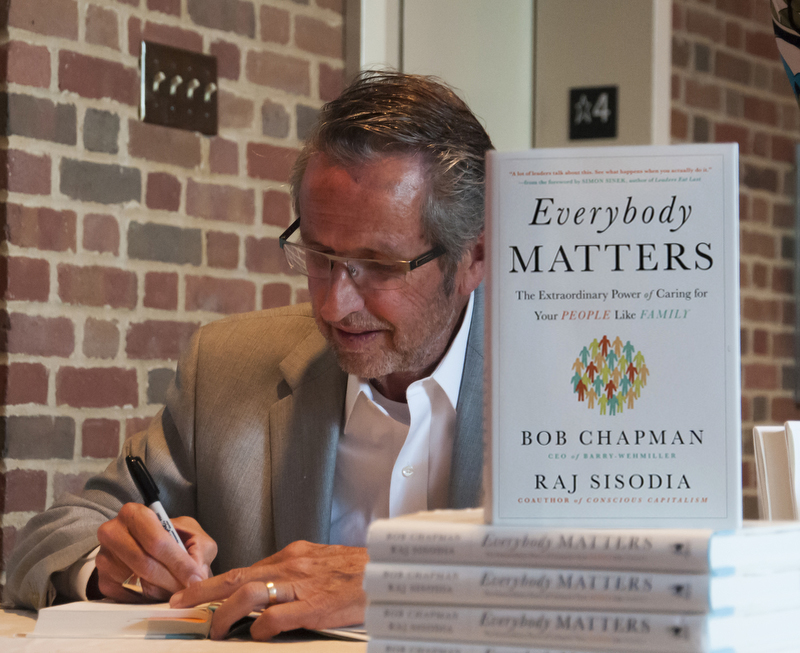 Barry-Wehmiller launches Everybody Matters Podcast (now called The Truly Human Leadership Podcast) to share the voices of other like-minded leaders also trying to change the world.
BW Leadership Institute (now Chapman & Co. Leadership Institute) is founded to share with other organizations Barry-Wehmiller’s learnings about leadership and fostering a people-centric culture.
Barry-Wehmiller launches Everybody Matters Podcast (now called The Truly Human Leadership Podcast) to share the voices of other like-minded leaders also trying to change the world.
BW Leadership Institute (now Chapman & Co. Leadership Institute) is founded to share with other organizations Barry-Wehmiller’s learnings about leadership and fostering a people-centric culture.
 Barry-Wehmiller acquires German-based companies Winkler+Dünnebier GmbH (W+D) and POEM GmbH from Körber AG.
 Everybody Matters documentary debuts, interweaving the story of the ups and downs of Barry-Wehmiller’s business with the transformation of the culture.
 Forsyth Capital Investors (now BW Forsyth Partners) establishes infrastructure equipment platform with the acquisition of HawkeyePedershaab Inc., headquartered in Mediapolis, Iowa (USA).
Harvard Business School publishes second case study about Barry-Wehmiller, this time exploring how the company’s views of responsibility for team members impact the business.
Forsyth Capital Investors (now BW Forsyth Partners) establishes infrastructure equipment platform with the acquisition of HawkeyePedershaab Inc., headquartered in Mediapolis, Iowa (USA).
Harvard Business School publishes second case study about Barry-Wehmiller, this time exploring how the company’s views of responsibility for team members impact the business.
 BW Packaging Systems debuts at Pack Expo, bringing together Accraply, BW Container Systems (now BW Integrated Systems), Hayssen Flexible Systems (now BW Flexible Systems), Pneumatic Scale Angelus, Synerlink and Thiele Technologies (now part of BW Flexible Systems and BW Integrated Systems) into one solutions-driven platform.
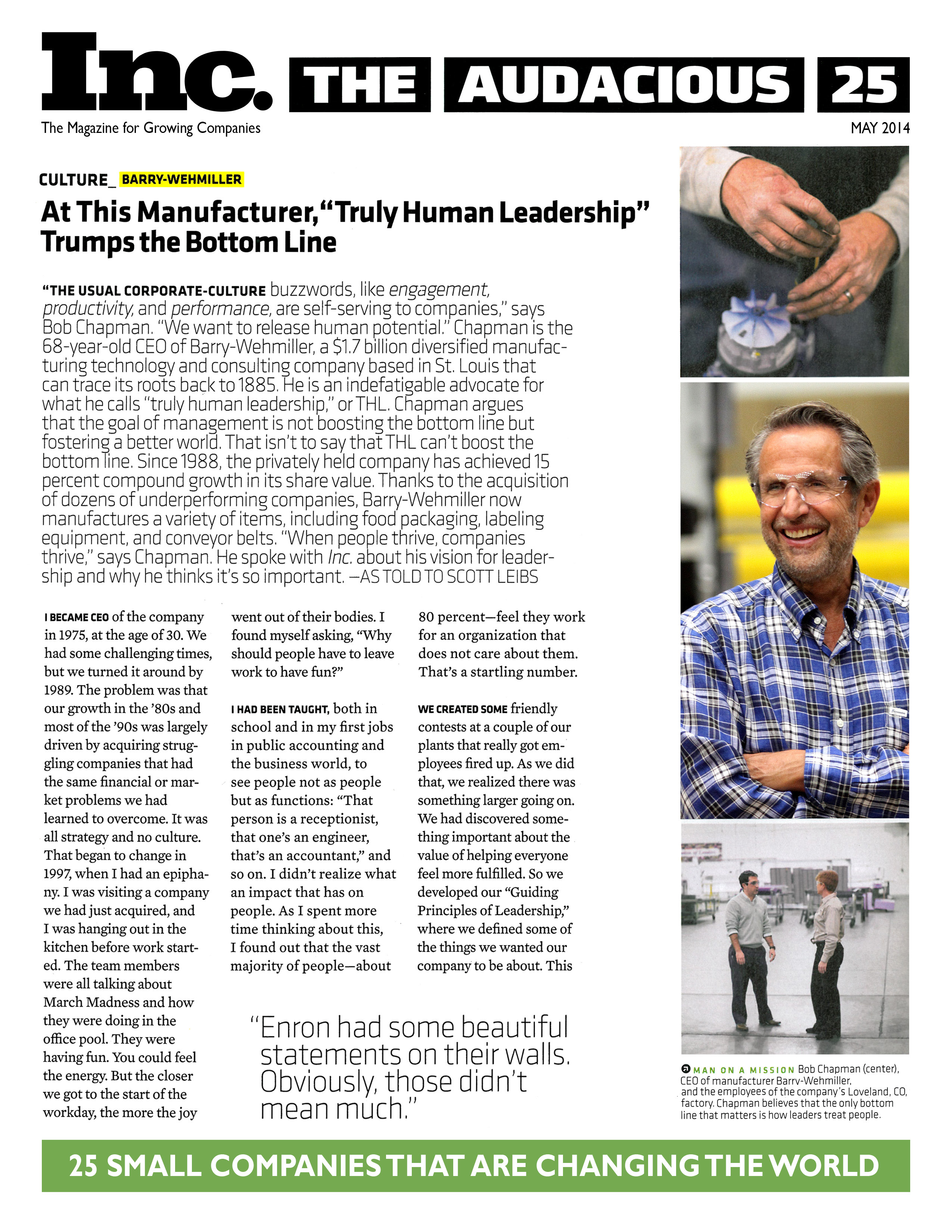
CEO Bob Chapman is named in Inc. magazine list of world’s top 10 CEOs.
BW Packaging Systems debuts at Pack Expo, bringing together Accraply, BW Container Systems (now BW Integrated Systems), Hayssen Flexible Systems (now BW Flexible Systems), Pneumatic Scale Angelus, Synerlink and Thiele Technologies (now part of BW Flexible Systems and BW Integrated Systems) into one solutions-driven platform.
CEO Bob Chapman is named in Inc. magazine list of world’s top 10 CEOs.
 Forsyth Capital Investors rebrands as BW Forsyth Partners.

 Barry-Wehmiller Design Group and Barry-Wehmiller International merge to form unified consulting platform.
BW Container Systems team and end-of-line teams from Thiele Technologies become BW Integrated Systems. Hayssen Flexible Systems team and bag-converting and bag-filling/palletizing teams of Thiele Technologies become BW Flexible Systems.
Barry-Wehmiller revenues exceed $3 billion and 12,000+ team members globally.
Barry-Wehmiller Design Group and Barry-Wehmiller International merge to form unified consulting platform.
BW Container Systems team and end-of-line teams from Thiele Technologies become BW Integrated Systems. Hayssen Flexible Systems team and bag-converting and bag-filling/palletizing teams of Thiele Technologies become BW Flexible Systems.
Barry-Wehmiller revenues exceed $3 billion and 12,000+ team members globally.
Barry-Wehmiller surpasses 100 acquisitions when its Winkler+Dünnebier GmbH division acquires BICMA Hygiene Technologie GmbH, based in Mayen, Germany.
Said Rhonda Spencer, Barry-Wehmiller's Chief People Officer: “The easy part of sharing our cultural vision in newly adopted companies is that, fundamentally, all people want the same things: to feel truly known, to feel they are making a valued contribution to something worthwhile and to be recognized for that contribution. It’s easy for people to buy into our vison. The challenge is to ensure that we live up to that vision for every team member.”
BW Leadership Institute (now Chapman & Co. Leadership Institute) adds Cape Town, South Africa, office.
Barry-Wehmiller acquires first Chinese company, Dongguan-based K&H Machinery Co. Ltd., which joins BW Papersystems.
First Marjorie E. Chapman Memorial College Scholarships are awarded to children of Barry-Wehmiller team members, in honor of CEO Bob Chapman’s mother’s commitment to education.
BW Leadership Institute (now Chapman & Co. Leadership Institute) launches TEDxClayton, a day-long event with speakers focused on “Shaping the Human Experience.”
BW Leadership Institute changes name to Chapman & Co. Leadership Institute.
Said Sara Hannah, Managing Partner of Chapman & Co.: “We are continually inspired by Bob’s vision to change the world through business. We want to help organizations become places that bring out the best in their people. This name change is the start of a new chapter - we’re excited to see where it takes us.” CEO Bob Chapman is honored with Entrepreneur Award from Arch Grants, a St. Louis, Missouri (USA), organization that helps small businesses as they are getting started.
CEO Bob Chapman’s son Kyle Chapman is promoted to president of Barry-Wehmiller after cofounding Forsyth Capital Investors (now BW Forsyth Partners) in 2009, serving in a strategic financial advisory role for Barry-Wehmiller from 2015 to 2019 (while co-leading BW Forsyth Partners) and then becoming Barry-Wehmiller’s interim chief financial officer in early 2020.
Said Kyle Chapman: “In this new role as president, my focus will be to continue to build upon our foundation as a vibrant company known for our culture of care, our commitment to validating the trust our customers place in us and continuing to invest in market-driven innovation — while reinforcing our belief that the only way to lead is with people and performance in harmony.”
Deemed an essential business, Barry-Wehmiller powers through the COVID-19 pandemic, achieving a record 14 percent share value gain. Many of its divisions contribute to COVID-19 relief efforts, from Barry-Wehmiller Design Group supporting vaccine development to Pneumatic Scale Angelus 3-D printing headbands for face shields, and from Synerlink leading a collaborative effort with Accraply and others to fill and overwrap hand sanitizer, to field service team members from all over consistently going above and beyond to serve customers. BW machines—including those from Baldwin Technology Company Inc., BW Papersystems and Winkler+Dünnebier GmbH—also prove essential, producing personal protective equipment when the world needs it most.
Said CEO Bob Chapman: “From working extra shifts to allow fellow team members who were immunocompromised to stay home, to sewing hundreds of masks when PPE was hard to come by, to finding a way to service a customer machine that went down and travel was challenging, our team members stepped up because we care about each other and the business. We’re proud that our performance validated again, during exceptionally challenging times, a business model design where a balance of markets, customers and technology were purposefully considered.”
Chapman & Co. Leadership Institute acquires Leadership Alliance, a firm focused on data-driven talent identification and development practices.
Chairman and CEO Bob Chapman returns to in-person speaking engagements as he shares the message of Truly Human Leadership at the Harvard SHINE Summit.
Chairman and CEO Bob Chapman hosts a meeting at the BW Papersystems location in Phillips, Wisconsin (USA), to discuss the initiative of “Humanizing Business Education.” Professors from Fordham University, Loyola University Chicago, Case Western Reserve, Bard, Creighton and St. Norbert College; as well as representatives from the UN, the Association of Jesuit Business Schools and Ashoka are in attendance.
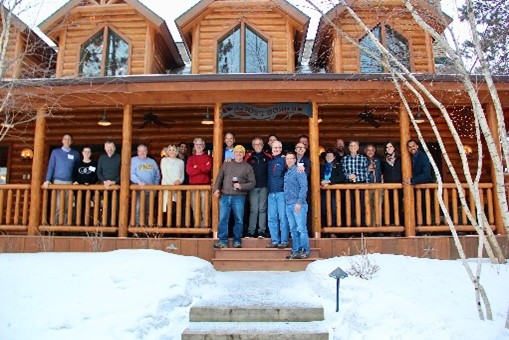 Chairman and CEO Bob Chapman, along with a group of leading university professors and business leaders from around the world, launch the Humanistic Leadership Academy to provide enriching, enlightening and empowering experiences to faculty and students so that they can reliably show up as humanistic leaders for others.
Chairman and CEO Bob Chapman highlights the initiatives to bring the message of Truly Human Leadership to educational institutions at the United Nations Transforming Education Summit on a panel organized by PRME (Principles for Responsible Management Education).
Chairman and CEO Bob Chapman is named Tharseō CEO of the Year by Society for Human Resource Management.
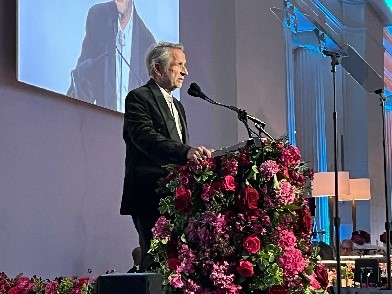
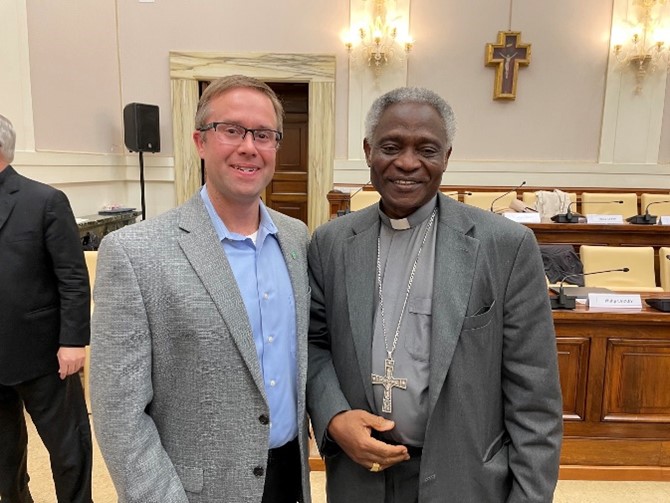
Brian Wellinghoff—Senior Director of Leadership & Outreach and Humanistic Leadership Academy Co-Founder—presents the message of humanistic leadership and human flourishing at the Vatican during the Humanity 2.0 conference.
Paper Converting Machine Company (PCMC), Winkler + Dünnebier (W+D), Baldwin Technology Co., Hudson-Sharp, STAX Technologies, and Northern Engraving and Machine unite under the BW Converting Solutions platform to bring innovative solutions to the print, packaging and converting industries.
 Revised and expanded 10th anniversary edition of Everybody Matters: The Extraordinary Power of Caring for Your People Like Family is released